The Taste Beneath
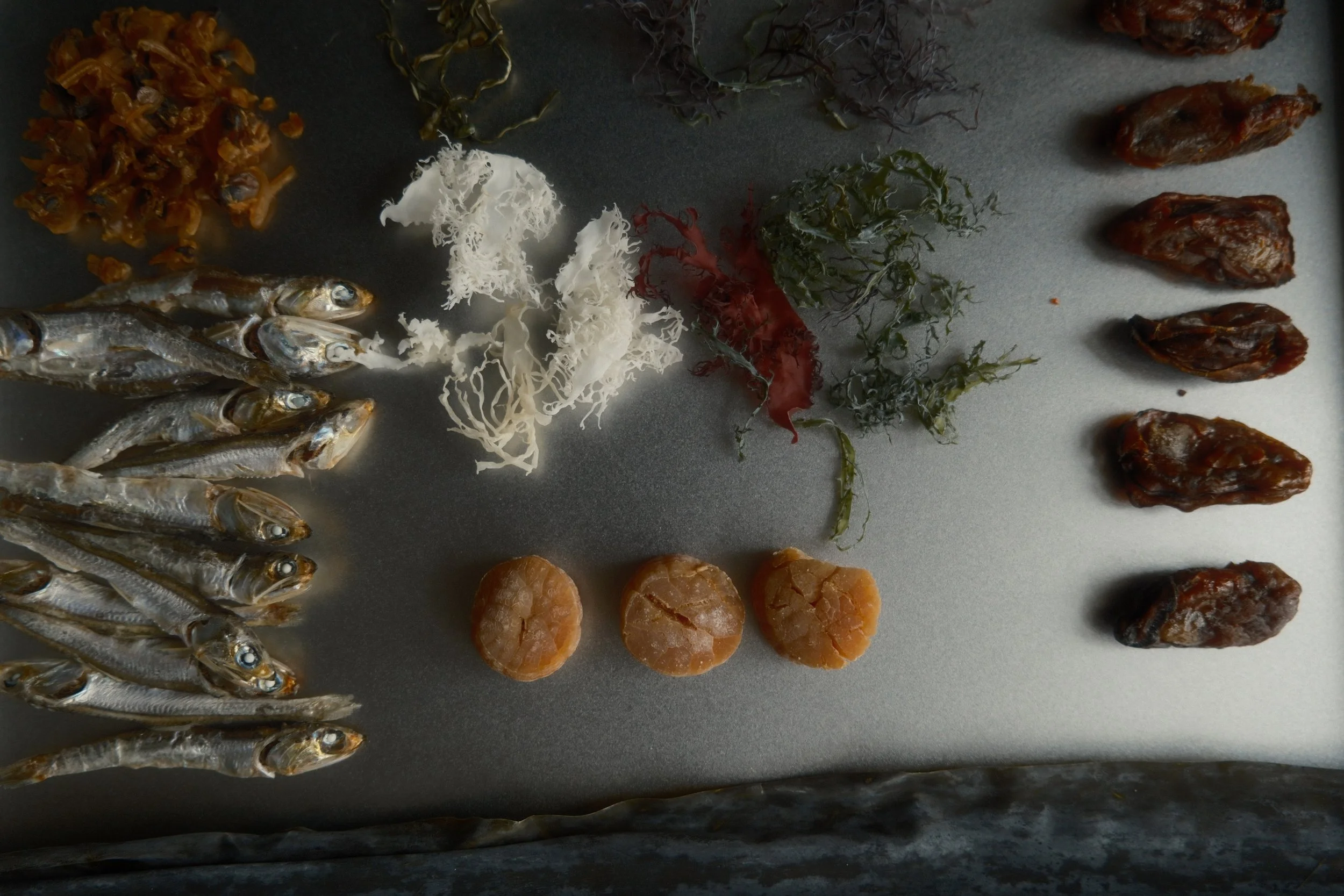
There are always a few things in my kitchen that do not look particularly exciting: kombu, dried anchovies, dried scallops, dried oysters, different kinds of seaweed. Dry, hard, sometimes wrinkled, sometimes quite strong in smell. They sit in jars and bags in the pantry until one day I need them, and then they are soaked, simmered, toasted, or simply left in water for a while.
I think I have always liked ingredients like this.
Partly because I grew up with them. In Cantonese cooking, 乾瑤柱 — dried scallop, 蠔豉 — dried oyster, 蝦米 — dried shrimp and dried mushrooms were just part of the kitchen. I never really thought of them as anything special. They were there in soups, braises and stocks, giving flavour quietly in the background.
Later, when I became more interested in Japanese cooking, I found the same idea again in 昆布 — kombu, 煮干し — niboshi, dried small fish, dried seaweed and other preserved ingredients. Different pantry, different language, but something about it felt very familiar.
Drying began as a way of keeping food for longer, of course, long before fridges and freezers. But what I find more interesting is what happens to the flavour. Something is taken away, but something else becomes stronger. Then, once water is added again, the ingredient does not really go back to what it was before. It becomes something different.
This is probably where 旨味 — umami, or savoury depth comes in.
Growing up speaking Cantonese, I never thought of that taste as something that needed a particular word. We would say 好甜 — naturally sweet, 好甘 — mellow and pleasantly sweet, or 好鮮甜 — fresh, savoury and naturally sweet. You taste a good soup and say 好鮮甜. Not because it is sweet in the sugary sense, but because everything feels rounded and complete.
Looking back, that was probably my first understanding of umami, long before I knew the Japanese word for it.
昆布 — kombu is perhaps the simplest example. It does not look like much when it is dry. You put it in water and leave it alone, and slowly the water changes. There is nothing dramatic about it, and I like that. Good dashi does not need to announce itself.
Kombu is naturally rich in glutamate, one of the things responsible for umami, and it was kombu dashi that led Kikunae Ikeda to identify and name 旨味 in the early twentieth century. I find that history interesting, but when I am actually cooking, I do not think about glutamate. I think about whether the broth tastes right.
At Cristjen’s Table, I use kombu all the time. Sometimes in dashi, sometimes under another broth, sometimes so quietly that nobody would ever know it was there. That is fine with me. I do not need every ingredient to be recognised. If the broth tastes complete, then it has done its job.
Dried anchovies are not quite so quiet. They can be salty, oily, slightly bitter, and sometimes quite strong. In Japanese cooking, 煮干し — niboshi, dried small fish used for stock are often used with kombu. Kombu brings glutamate, fish brings inosinate, and together the flavour becomes deeper. There is science behind that, but in the kitchen I think of it more simply: some ingredients just work better together.
I have also used dried anchovies in 八寸 — hassun, a seasonal course of several small bites at Cristjen’s Table, where they stay whole instead of disappearing into a stock. Crisp, glazed, salty, a little sweet, slightly bitter. I like having one bite in a course that is a little louder than the others.
Dried scallop and dried oyster feel more personal to me. 乾瑤柱 — dried scallop and 蠔豉 — dried oyster are ingredients I knew long before I started cooking Japanese food seriously. Once soaked, they soften and the liquid changes. The smell becomes gentler, the water becomes sweet, and slowly they give almost everything they have to the broth.
This is where those Cantonese words come back again: 好甜, 好甘, 好鮮甜.
A good broth made with dried scallop does not taste sweet because sugar has been added. The sweetness comes from the ingredient itself. It is softer, rounder, and quite difficult to explain if you did not grow up tasting it.
I use dried scallop and dried oyster in Kaiseki no Umi — “the sea of kaiseki”, one of the dishes that has gradually become part of Cristjen’s Table. The finished broth is clear and quite restrained, but underneath it are ingredients that have been soaking and giving flavour for hours. By the time the bowl reaches the table, most of that work is invisible.
I think I like cooking that way.
The important part is not always the thing you see first. Sometimes it is the broth underneath, the seasoning made earlier, or an ingredient that has already given everything it has and is no longer on the plate at all.
The same goes for 海藻 — kaisō, seaweeds. I use different seaweeds with seafood because I like the texture and the salinity, but also because it simply makes sense to me. Seafood with things from the sea. Once rehydrated, they can be beautiful too — white, red, pink, dark green, sometimes almost transparent.
I suppose dried ingredients also suit the way I like to cook because they ask for time. Kombu needs time in water. Dried scallops and oysters need soaking. Seaweed needs to soften. There is not really much to do except prepare them properly and wait.
I quite like that.
Not everything needs to happen quickly.
Sometimes umami is talked about as though more is always better, but I do not really agree. Too much stock, too much dried seafood, too much soy, too much reduction, and everything can become heavy. What I want is something quieter: depth without weight. A clear broth that still feels complete. A piece of fish that can stay delicate. Flavour that sits underneath instead of pushing itself forward.
Maybe that is why I keep coming back to these ingredients. They are humble, they keep well, and most of the time they sit quietly in the pantry. Then one day you soak them, and hours later they become the thing holding the whole dish together.
Some come from Japanese cooking. Some come from the Cantonese food I grew up with. Some sit somewhere in between. I do not really feel the need to separate them.
They are simply part of the way I cook now.
And perhaps that is what 旨味 — umami means to me more than anything else. Not more flavour, not louder flavour, just enough underneath everything to make the dish feel whole.
Or, as I would probably have said long before I knew the word umami:
好鮮甜 — so fresh, savoury and naturally sweet.